Podcast and audio publishing
Podcast and audio publishing
Host, master, transcribe, and publish podcast and audio content on Quake AI Compute and Object Storage. You operate RSS feed generation, enclosure URLs, and CDN settings; Quake AI provides compute for publishing workers, Object Storage for episode libraries, and networking for public endpoints.
What this is for#
Podcasters and audio publishers who want to own their feed and library run the publishing pipeline themselves instead of renting a hosting SaaS. Quake AI provides compute for mastering, transcoding, and transcription workers, plus object storage for the episode library and RSS document; you operate the feed generation and CDN configuration. The outcome is an owned audio publishing stack with flat egress, deployable from validated OpenTofu templates and their companion tutorials.
Reference architecture#
Download diagram: SVG, PNG, and PDF.
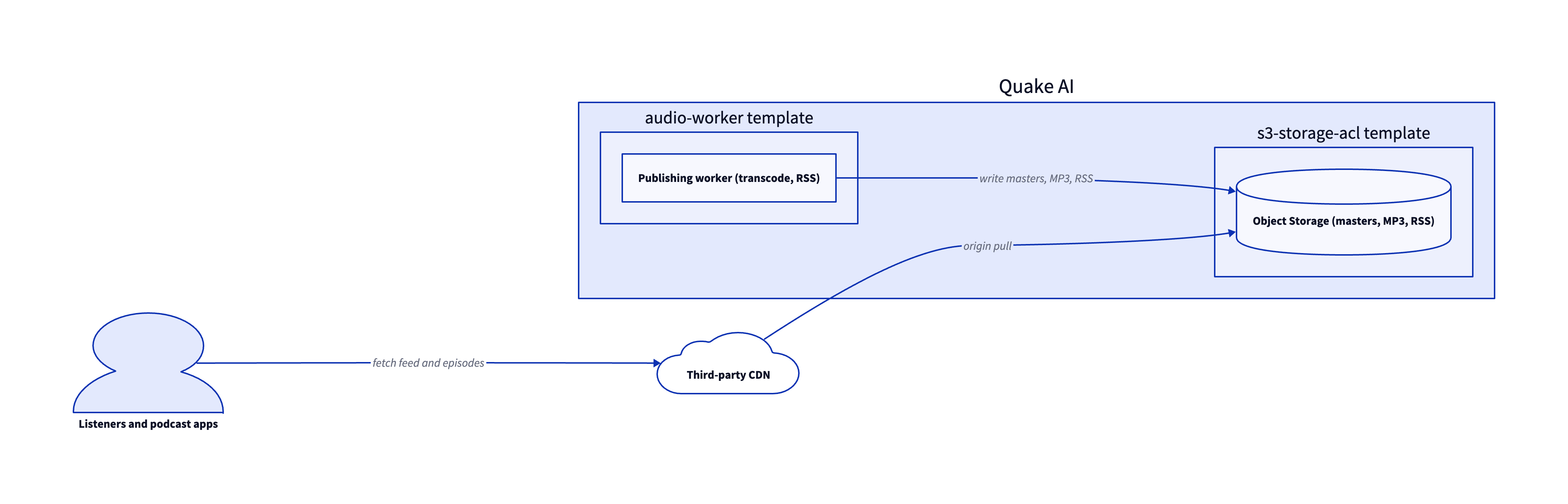
The base is two validated templates: the Audio worker template runs the CPU worker that masters, transcodes, and generates the feed, and the S3 Storage with ACLs template holds the episode library and RSS document. A third-party CDN fronts the bucket for listener delivery. A Simple VM is an alternative worker host when you do not need the audio-worker preset.
-
Listeners and podcast apps. Subscribers fetch the RSS feed and pull episode enclosures over HTTPS, typically through a CDN.
-
Third-party CDN. A CDN such as Cloudflare or Fastly caches episode objects and serves them close to listeners. Quake AI has no native CDN product, so you bring the provider and point it at the bucket as origin.
-
Publishing and transcode worker. A Compute instance runs the feed generator, audio normalization, and optional transcription. The Audio worker template provisions the CPU worker host; a Simple VM is the alternative when you configure the worker yourself.
-
Object Storage library. Masters, normalized MP3s, cover art, and the RSS document live in S3-compatible Object Storage. The S3 Storage with ACLs template provisions the bucket and ACL policy.
Services involved#
| Service | Role in this architecture | Docs |
|---|---|---|
| Compute | Hosts the feed generator and transcode worker | Compute |
| Object Storage | Episode library, cover art, and RSS document | Object Storage |
| Network | HTTPS path for the public feed and enclosure endpoints | Network |
Get started#
- Simple VM template and its deploy tutorial: single Compute instance for a feed generator, transcoding worker, or lightweight publishing app.
- Audio worker template and its deploy tutorial: CPU worker for transcode, normalization, and transcription jobs.
- S3 Storage with ACLs template and its deploy tutorial: Object Storage bucket with ACL policy for your episode and asset library.
- Upload objects to Object Storage: store masters, normalized MP3s, and cover art in the bucket your template provisions.
- OpenTofu template library: browse validated IaC starting points for publishing and storage layouts.
Estimate the cost#
Monthly cost estimate
Pricing calculator ↗Sized as a custom package on dedicated vCPU.
Monthly total for the required template above. Use the configurator below to add optional pieces and see the total update.
What each resource is for
Worker node
c2a.large · 2 dedicated vCPU, 4 GiB RAM, 0.5 Gbps
Compute shown per role at custom-package rates ($29/dedicated vCPU, $7.25/shared vCPU, $1/GiB RAM). The headline above is the billed total: the cheaper of a named plan and the custom package, plus add-ons.
Included in baseline
c2a.large
2 dedicated vCPU, 4 GiB RAM, 0.5 Gbps
Compute + RAM rate basis
2 vCPU + 4 GiB RAM at $29/dedicated vCPU, $7.25/shared vCPU, $1/GiB RAM (regular). Totals apply the flat −$5/mo package promotion.
Block storage (40 GiB)
40 GiB at $0.08/GiB/mo
Package promotional discount
Flat −$5.00/mo on the custom package (same promotion as named plans).
Object storage (usage-based)
Object storage
2 buckets. The first 1 TB is included, then $10.00 per TB each month. You pay for what you store, so this line depends on usage.
Assumes: 2 TB stored is $10/mo; 5 TB stored is $40/mo. Within the included allotment it stays $0.
Included at no charge
These line items are zero on Quake AI. Many other providers meter them separately.
Data transfer (inbound and outbound)
Unlimited data transfer on every plan; Quake AI does not meter per-GB egress.
AWS, GCP, and Azure meter outbound transfer per GB. DigitalOcean and Hetzner include an allowance on compute plans, then charge overage.
Learn moreObject storage upload and download
No separate charges for uploading or downloading object storage data.
Most object storage providers meter egress and API requests separately from stored capacity.
Learn morePrivate networking
Private networks, subnets, Neutron routers, and security groups are included with the plan.
VPC objects are usually free to create elsewhere, but NAT gateways bill hourly plus per-GB processed. Quake AI uses router SNAT with no separate NAT line item.
Control-plane API requests
OpenStack API calls for provisioning and management are included.
Some managed services on other clouds meter API calls or charge for premium control-plane features.
Configure your estimate
Check the add-ons you plan to deploy to build a monthly total. Nothing is selected to start, so the total below begins at the baseline.
Starting template
The required baseline, always included.
Pick how much you expect to store to fold it into the total.
Dev/test vs production
Start on shared CPU for dev/test, then promote to dedicated for production with a flavor resize. The network, storage, and template stay the same.
Dev/test on shared CPU
Burstable s1a flavors; suited to prototyping and low or bursty load.
Production on dedicated CPU
The headline estimate above; predictable steady-load performance.
Saves $45.50/mo while you build on shared CPU.
Shared flavors carry less RAM (c2a.large (4 GiB RAM) -> s1a.small (2 GiB RAM)). A resize reboots the instance; data on attached volumes persists. Size the dedicated flavor for the RAM your production workload needs.
Pricing data last validated: . For current rates, check quake.ai/pricing.
Migrating an existing podcast / audio publishing workload?#
Move a podcast or audio publishing stack that already runs on AWS EC2 and S3, another hyperscaler, or a SaaS host. The outcome is the same episode library on Quake AI Object Storage with RSS, enclosure URLs, and CDN configuration cut over in a controlled order.
Follow this cutover path. Each step links an existing migration page; this section composes those pages into a workload-shaped sequence rather than duplicating their steps.
-
Map your source provider. Start with the concept-translation page for your current cloud: Coming from AWS, Coming from Azure, Coming from GCP, Coming from DigitalOcean, or Coming from Hetzner.
-
Stand up the target shape on Quake AI. Pick the greenfield templates that match your publishing layout: Simple VM for a feed or worker VM, and S3 Storage with ACLs for the audio library bucket.
-
Move compute workloads. Rebuild or migrate feed generators, transcode workers, and publishing VMs with Migrate from EC2 (or the matching compute migration page for your source provider).
-
Sync the audio library. Copy episode files, masters, and cover art with Migrate from S3 (or the matching object migration page for your source provider).
-
Update RSS and CDN endpoints. Publish the new feed URL and enclosure base path, configure your CDN or reverse proxy to serve episode objects from the Quake AI bucket, then switch the public hostname when validation passes.
Workload-specific cutover callouts#
- Audio-library bucket sync. Plan a bulk object copy with integrity checks (ETag or checksum validation) before you change enclosure URLs in the feed. Resume interrupted transfers and spot-check recent episodes after sync completes.
- RSS and CDN endpoint update. Quake AI has no native CDN product. Update your CDN provider (Cloudflare, Fastly, or similar) and any dynamic feed generator so
<enclosure>URLs resolve to the Quake AI Object Storage path or signed URL pattern you provisioned. - Feed continuity. Validate the RSS XML after URL changes: every enclosure must return HTTP 200, byte length must match the feed metadata, and podcast apps that cache feeds should see stable episode identifiers across the cutover window.
- Rollback path. Keep the source bucket and feed endpoint available until subscriber playback error rates stabilize. Roll back by restoring the previous feed document and CDN origin configuration if validation or health checks fail.
Considerations and limits#
- You operate publishing and the feed. Quake AI provides compute and storage; RSS generation, enclosure URLs, and transcription are yours under the shared responsibility model.
- No native CDN. Quake AI has no CDN product. Front the episode bucket with a third-party CDN for listener-facing delivery.
- CPU-only compute. Compute is AMD EPYC with no GPU option (compute FAQ). CPU workers fit audio transcode, normalization, and speech-to-text on smaller models.
- Flat egress. Quake AI applies a no-egress-fee policy for outbound transfer, which suits feeds that serve large audio files to many subscribers.
- Three US regions. All current regions are in the United States. Global delivery relies on the CDN layer in front of the origin.
- Compliance posture. Quake AI holds SOC 2 Type I and Type II attestations and SOC 3. See Compliance and certifications for the platform scope.