Self-service BI stack
Self-service BI stack
Run self-service dashboards on Quake AI by composing a BI tool, an analytical warehouse, and an Object Storage lake. You operate the BI instance, warehouse, and lake access; Quake AI provides Compute, Block Storage, Object Storage, and networking underneath. This architecture targets teams that want Looker- or Tableau-class dashboards on infrastructure they control, with plan-based pricing instead of per-seat or per-query SaaS billing.
What this is for#
Data analysts and analytics engineers who need SQL-backed dashboards and ad hoc exploration build a three-tier stack: a BI front end (Metabase or Apache Superset), a warehouse for query-ready tables (self-managed Postgres or ClickHouse), and Object Storage for raw exports and curated files. Quake AI hosts each tier on Compute and storage you provision; you connect the BI tool to the warehouse after deploy and load data from the lake or upstream sources. The outcome is a self-operated BI platform, deployable from validated OpenTofu templates and their companion deployment pages.
Reference architecture#
Download diagram: SVG, PNG, and PDF.

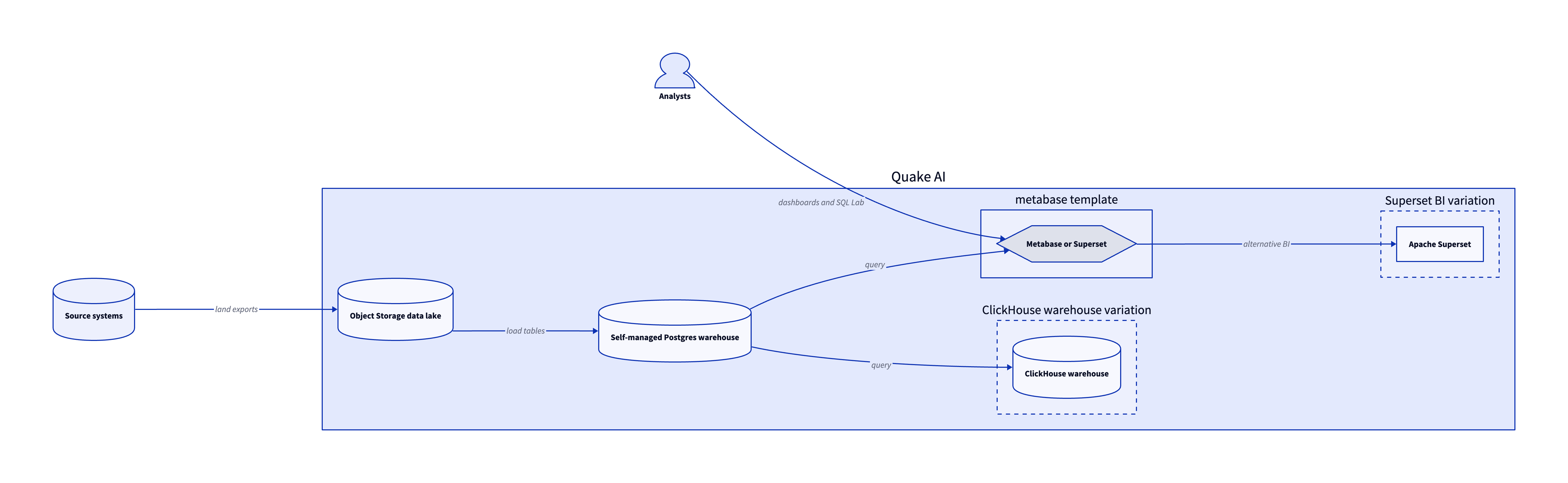
The stack has four layers. Each maps to a validated template and a deployment page.
-
Source systems. Application databases, SaaS exports, and scheduled dumps feed the lake or load directly into the warehouse.
-
Object Storage lake. Raw CSV, Parquet, and JSON exports land in an S3-compatible Object Storage bucket. The S3 Storage with ACLs template provisions the bucket and credentials endpoint.
-
Analytical warehouse. Query-ready tables live in a self-managed Postgres instance on Block Storage. The self-managed PostgreSQL template provisions the database host, volume, and network. For heavier aggregate workloads, ClickHouse is an optional column-store alternative with its own template.
-
BI tool. Analysts reach Metabase or Apache Superset over HTTPS. Each template provisions a Compute instance, private network, and block volume for the app stack. You register the warehouse as a datasource in the BI UI after first boot; neither template ships warehouse credentials.
Services involved#
| Service | Role in this architecture | Docs |
|---|---|---|
| Compute | Hosts the BI tool, Postgres warehouse, and optional ClickHouse node | Compute |
| Object Storage | Data lake for raw exports, curated files, and BI cache artifacts | Object Storage |
| Block Storage | Postgres and ClickHouse data volumes; BI app persistent state | Block Storage |
| Network | Private networks, security groups, and floating IPs for each tier | Network |
Get started#
Each template below pairs with a step-by-step deployment page. Stand up the warehouse and lake first, then deploy the BI tool and connect it to the warehouse in the UI.
- Metabase template and its deployment page: lightweight BI dashboards and question builder; a self-hosted alternative to Looker or Power BI.
- Apache Superset template and its deployment page: SQL Lab and richer chart types; a self-hosted alternative to Tableau or Sigma.
- Self-managed PostgreSQL template and its deployment page: the Postgres warehouse on Block Storage.
- ClickHouse template and its deployment page: optional column-store warehouse for large aggregate queries.
- S3 Storage with ACLs template and its deployment page: the Object Storage data lake.
- OpenTofu template library: browse validated IaC starting points for the tiers above.
Estimate the cost#
Monthly cost estimate
Pricing calculator ↗Sized as a custom package on a mix of shared and dedicated vCPU.
Monthly total for the required template above. Use the configurator below to add optional pieces and see the total update.
What each resource is for
Metabase host
s1a.small · 2 shared vCPU, 2 GiB RAM, 0.5 Gbps
Runs Metabase in Docker for self-service BI dashboards and SQL questions against your warehouse.
Metabase with the embedded H2 app database runs on 2 vCPU and 2 GiB RAM. Size up for many concurrent users or when you use an external Postgres app database.
PostgreSQL database
m2a.xlarge · 4 dedicated vCPU, 16 GiB RAM, 1 Gbps
Compute shown per role at custom-package rates ($29/dedicated vCPU, $7.25/shared vCPU, $1/GiB RAM). The headline above is the billed total: the cheaper of a named plan and the custom package, plus add-ons.
Included in baseline
s1a.small
2 shared vCPU, 2 GiB RAM, 0.5 Gbps
m2a.xlarge
4 dedicated vCPU, 16 GiB RAM, 1 Gbps
Compute + RAM rate basis
6 vCPU + 18 GiB RAM at $29/dedicated vCPU, $7.25/shared vCPU, $1/GiB RAM (regular). Totals apply the flat −$5/mo package promotion.
Block storage (120 GiB)
120 GiB at $0.08/GiB/mo
Public IP (included)
1 included with the custom package
Package promotional discount
Flat −$5.00/mo on the custom package (same promotion as named plans).
Included at no charge
These line items are zero on Quake AI. Many other providers meter them separately.
Data transfer (inbound and outbound)
Unlimited data transfer on every plan; Quake AI does not meter per-GB egress.
AWS, GCP, and Azure meter outbound transfer per GB. DigitalOcean and Hetzner include an allowance on compute plans, then charge overage.
Learn morePrivate networking
Private networks, subnets, Neutron routers, and security groups are included with the plan.
VPC objects are usually free to create elsewhere, but NAT gateways bill hourly plus per-GB processed. Quake AI uses router SNAT with no separate NAT line item.
Control-plane API requests
OpenStack API calls for provisioning and management are included.
Some managed services on other clouds meter API calls or charge for premium control-plane features.
Configure your estimate
Check the add-ons you plan to deploy to build a monthly total. Nothing is selected to start, so the total below begins at the baseline.
Starting template
The required baseline, always included.
Dev/test vs production
Start on shared CPU for dev/test, then promote to dedicated for production with a flavor resize. The network, storage, and template stay the same.
Dev/test on shared CPU
Burstable s1a flavors; suited to prototyping and low or bursty load.
Production on the configured CPU
The headline estimate above; predictable steady-load performance.
Saves $99.00/mo while you build on shared CPU.
Shared flavors carry less RAM (m2a.xlarge (16 GiB RAM) -> s1a.medium (4 GiB RAM)). A resize reboots the instance; data on attached volumes persists. Size the dedicated flavor for the RAM your production workload needs.
Pricing data last validated: . For current rates, check quake.ai/pricing.
Considerations and limits#
- Self-managed stack. Quake AI provides compute and storage, not a hosted data warehouse or hosted BI service. Your team operates Postgres or ClickHouse, the BI instance, and datasource credentials under the shared responsibility model.
- You wire the warehouse to the BI tool. Templates provision each tier independently. After deploy, register the warehouse connection in Metabase or Superset; no credential ships between templates.
- CPU-only compute. Compute is AMD EPYC with no GPU option (compute FAQ). BI and warehouse tiers run on CPU; GPU-accelerated query engines need a different hosting path.
- Superset footprint. Apache Superset runs a multi-container stack (web, worker, metadata database, cache) and needs more RAM than Metabase on the same analyst count. Size the instance from the Superset template defaults before you share the URL with a team.
- Flat egress. Quake AI applies a no-egress-fee policy for outbound transfer, which helps when analysts export large result sets or sync lake files.
- Three US regions. All current regions are in the United States.
- Compliance posture. Quake AI holds SOC 2 Type I and Type II attestations and SOC 3. See Compliance and certifications for the platform scope.