API Access Console Reference
Coming from another cloud?
▸AWS·IAM Console
This Quake AI feature maps to AWS’s IAM Console.
▸DigitalOcean·API Console
This Quake AI feature maps to DigitalOcean’s API Console.
▸Hetzner·API Token
API Tokens (project-scoped Bearer tokens)
- Hetzner API tokens are project-scoped: each token is valid only for the project it was created in and must be separately generated per project. OpenStack Keystone application credentials are user-scoped and can be used across projects when the user has appropriate roles.
- Hetzner has no OAuth2/OIDC integration for API access; all programmatic access requires a static bearer token. Keystone supports OIDC federation, LDAP backends, and federated identity (SAML2).
- Hetzner tokens have no built-in expiry and must be manually rotated; there is no token TTL or refresh concept. Keystone tokens have configurable TTLs (default 1 hour) and support re-authentication.
- Hetzner tokens are either read-only or read-write with no fine-grained scope. OpenStack roles (admin, member, reader) provide service-level access control per project.
API access console reference
The API section in the Quake AI console ({CONSOLE_REGION_URL}/papi/*) provides tools for managing programmatic access to your cloud project. It contains three pages (S3 Credentials, App Credentials, and API Endpoints) plus a Get Token action on the endpoints page.
S3 credentials#
Console path: API > S3 Credentials ({CONSOLE_REGION_URL}/papi/s3-credentials)
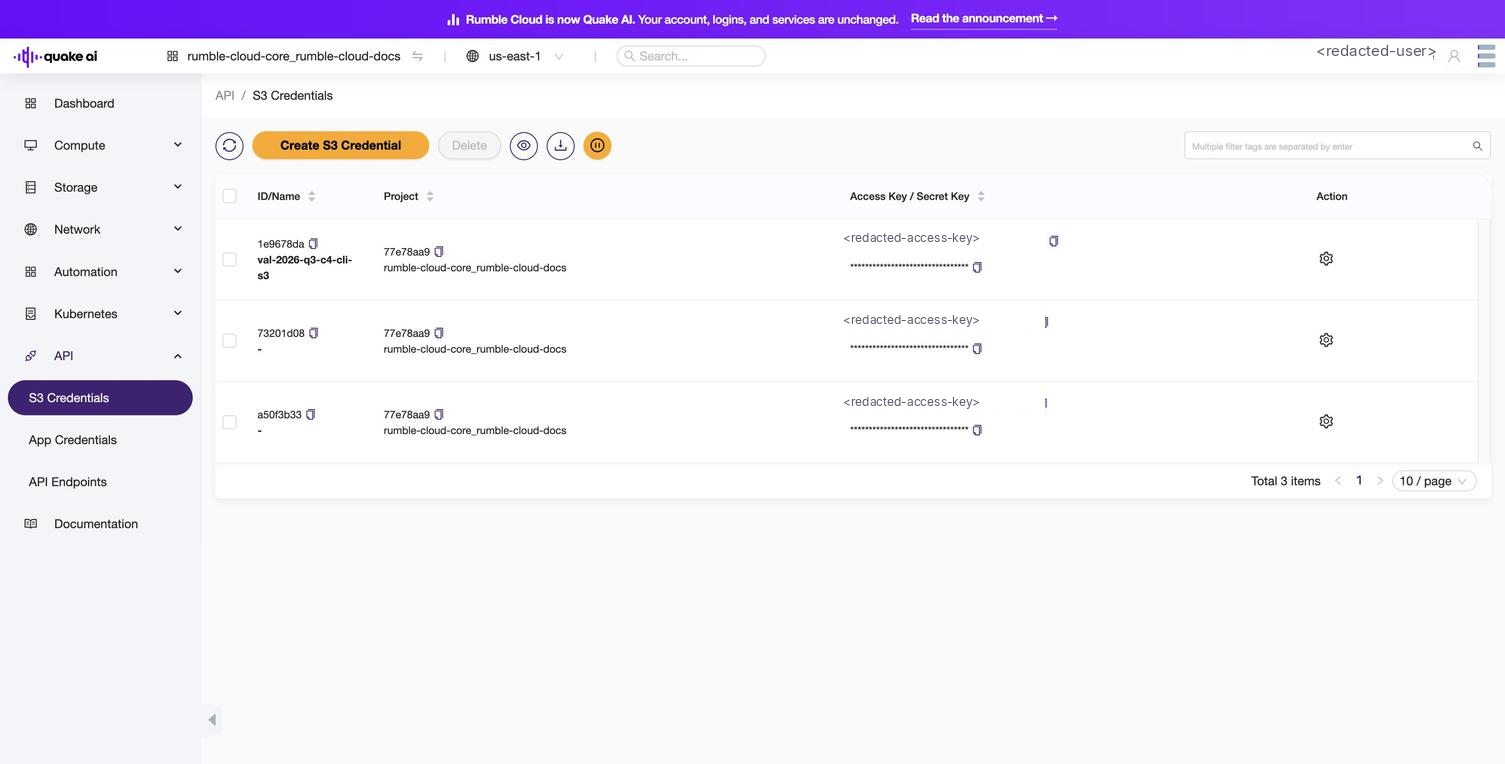
Manage EC2-compatible credentials for S3 object storage access. Unlike application credentials, S3 credentials are scoped to your user account, not a single project.
 Click to zoom
| Column | Description |
|---|---|
| ID/Name | Credential identifier and the name you assigned at creation |
| Project | The project the credential was created under |
| Access Key / Secret Key | The access key shown in full and the masked secret key, each with a copy icon |
| Action | The per-row settings menu |
Actions: Create S3 Credential; per-row settings menu: s3cmd config, Delete; inline copy icons in the Access Key / Secret Key column
How-to: Create S3 credentials
Application credentials#
Console path: API > App Credentials ({CONSOLE_REGION_URL}/papi/application-credentials)
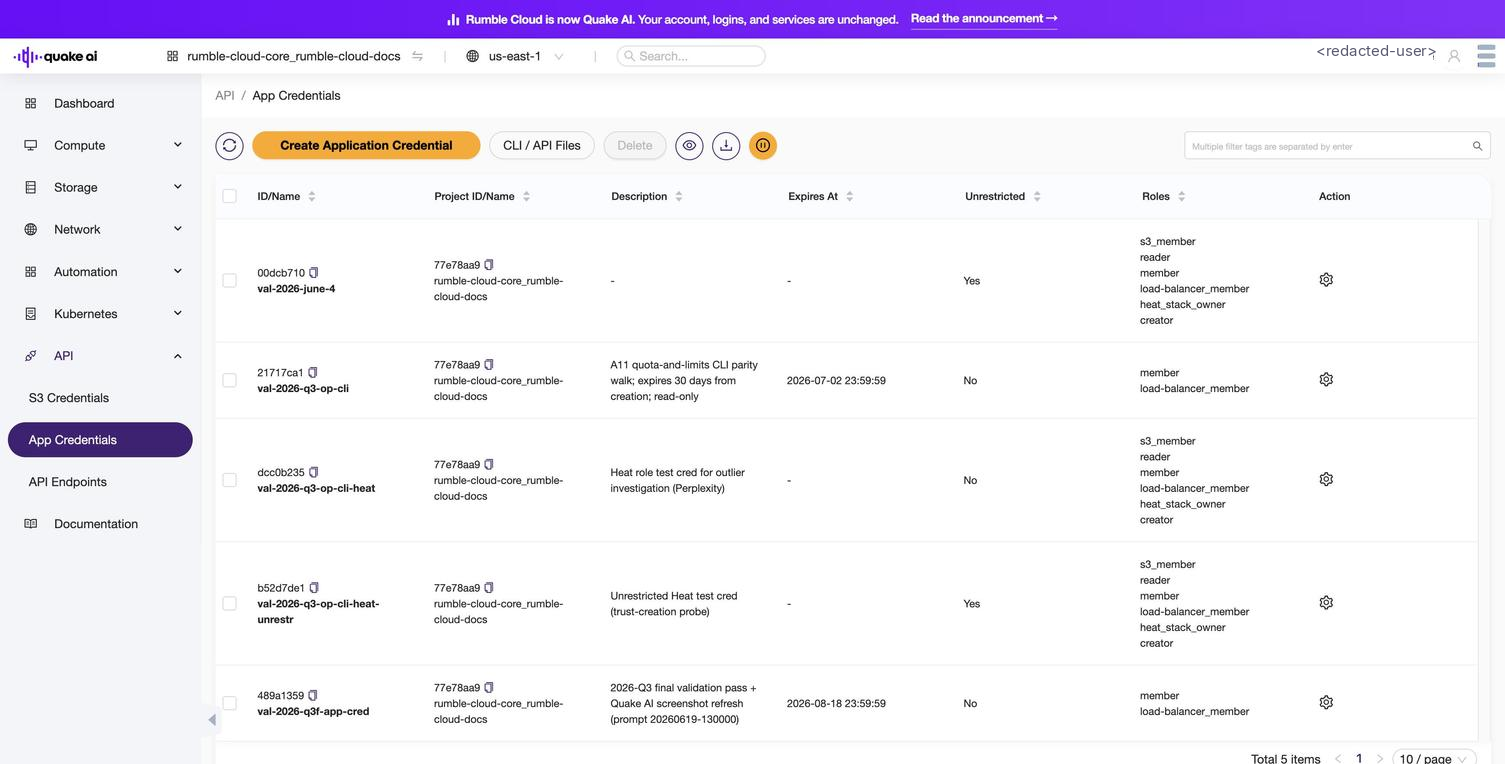
Create and manage application credentials for authenticating the OpenStack CLI, SDKs, and Terraform without your account password. Each credential is scoped to the current project.
 Click to zoom
| Column | Description |
|---|---|
| ID/Name | Credential identifier and the name you assigned |
| Project | The project this credential is scoped to |
| Description | Optional description set during creation |
| Expires At | Expiration date, if set |
| Unrestricted | Whether the credential can manage trusts, other credentials, and Kubernetes clusters |
| Roles | Roles assigned to this credential |
Actions: Create Application Credential, Delete
How-to: Create application credentials
API endpoints#
Console path: API > API Endpoints ({CONSOLE_REGION_URL}/papi/endpoints)
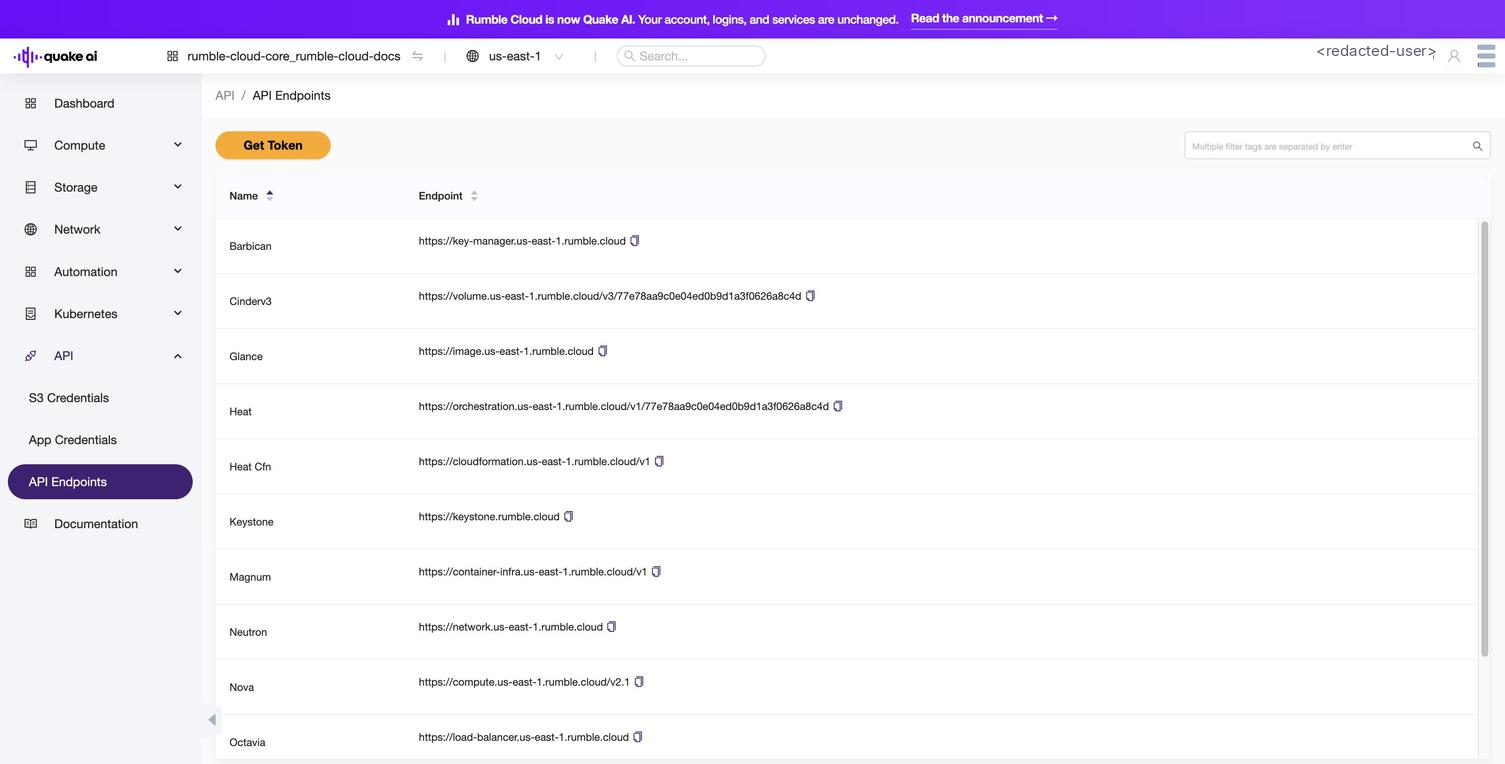
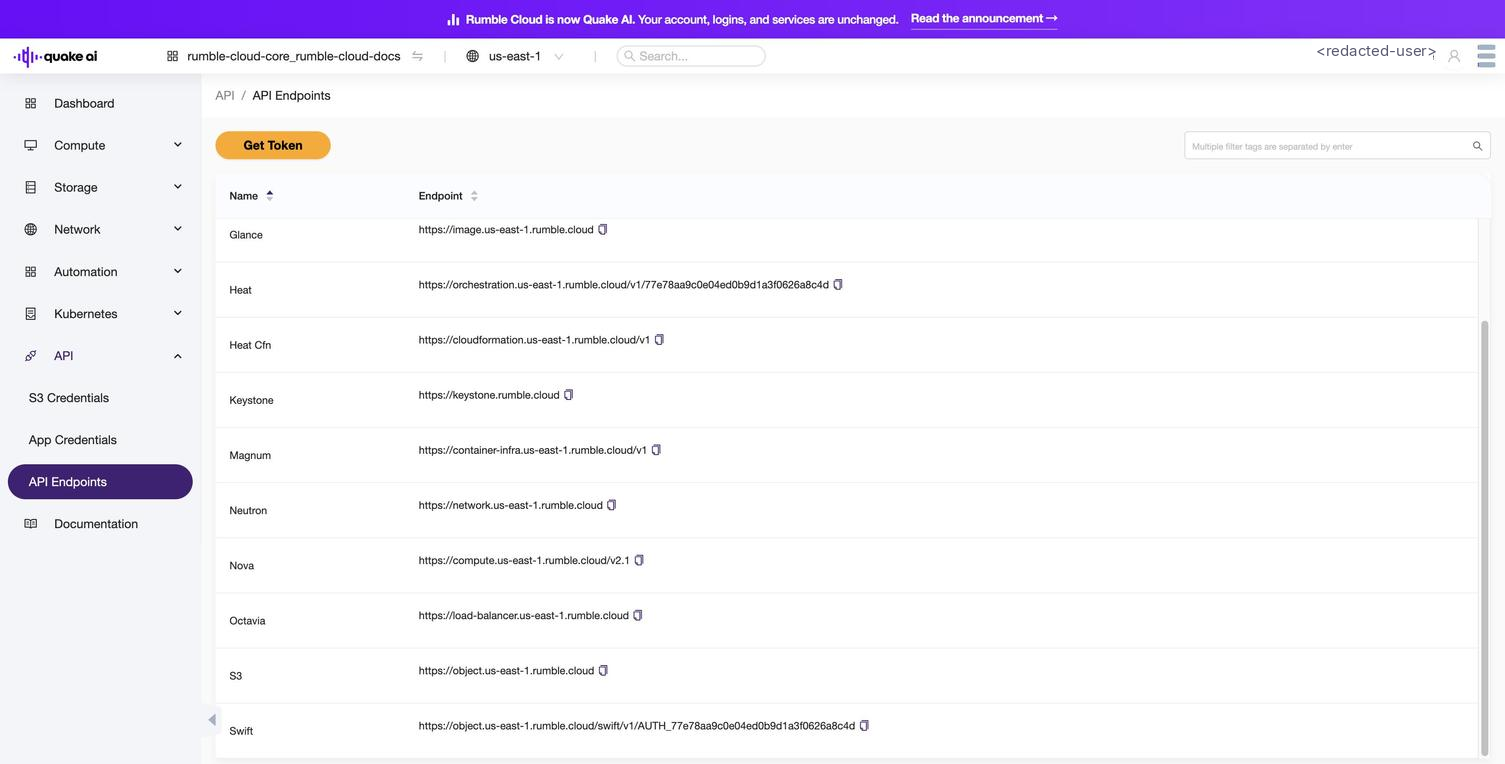
View all service endpoint base URLs for your project. This page lists the same endpoints available through the Keystone service catalog, resolved for your region and project.
 Click to zoom
 Click to zoom
The endpoint table includes Compute (Nova), Network (Neutron), Block Storage (Cinder), Images (Glance), Object Storage (Swift/S3), Identity (Keystone), Orchestration (Heat), and Container Infrastructure (Magnum).
Reference: Service Endpoints: full endpoint table with clouds.yaml example and endpoint discovery details
Get token#
Console path: API > API Endpoints > Get Token button
Generate a project-scoped Keystone token directly from the console. The token authenticates direct HTTP requests to the service endpoints. Tokens are valid for 24 hours.
The Get Token button appears on the API Endpoints page. After selecting it, the console displays the token value with a copy action.
How-to: Get an API token
See also#
- Access & Credentials overview: section landing page
- Service Endpoints: all 12 base URLs,
clouds.yaml, endpoint discovery - API Endpoints console: endpoint table with API reference links
- API versions and microversions