Skip to content

Instance Snapshots Console

Reference · Updated Sep 2026

Coming from another cloud?

▸AWS·EC2 Instances

EC2 Instanceshigh

  • Uses EC2 RunInstances API instead of Nova servers.create.
  • Requires predefined instance type selection.
  • Supports per-second On-Demand billing and Spot/Reserved options.
  • Includes hibernation state not standard in OpenStack.
AWS docs ↗
▸Azure·Virtual Machines

Virtual Machineshigh

  • Uses Azure Resource Manager (ARM) REST API at /providers/Microsoft.Compute/virtualMachines instead of OpenStack Nova API at /v2.1/servers.
  • Tightly integrated with Azure services like Azure Active Directory for authentication, unlike OpenStack's Keystone.
  • VM creation requires specifying size from predefined series with hardware-specific features (e.g., AMD/Intel/ARM), not custom flavor configs.
  • Billed per second with complex pricing tiers based on series/reservation options, vs OpenStack's typically hourly or usage-based.
Azure docs ↗
▸DigitalOcean·Droplets

Dropletshigh

  • API surface is DigitalOcean’s proprietary REST/CLI/Terraform tooling rather than OpenStack Nova/Neutron/Glance APIs (Droplets are managed via DigitalOcean UI/CLI/API/Terraform).
  • Billing is usage-based with per-second billing (60-second minimum and monthly cap) rather than the typical per-hour, quota-based charge model users often see in OpenStack-based clouds.
  • Droplets include a bundled outbound transfer allowance with each plan (starting at 500 GiB/month) rather than a separate bandwidth quota/metering model users often encounter in OpenStack deployments.
  • Droplets are described as Linux-based VMs on virtualized hardware with local SSD storage, whereas OpenStack deployments commonly expose distinct block storage (Cinder) and image services (Glance) and may not bundle bandwidth/monitoring/firewalls into the instance offering.
DigitalOcean docs ↗
▸Google Cloud·VM instances

VM instanceshigh

  • Uses REST API 'instances.insert' instead of Nova 'servers.create' with different auth via service accounts vs Keystone.
  • Supports bare metal instances (no hypervisor), not in standard OpenStack Nova.
  • Network interfaces tied to VPC subnets; differs from Neutron ports/floating IPs.
Google Cloud docs ↗
▸Hetzner·Cloud Servers

Cloud Servershigh

  • Servers provisioned individually via Hetzner API (hcloud), not OpenStack Nova flavors; fixed instance types like CX11 (1 vCPU, 2GB RAM, 20GB NVMe).
  • No flavor customization; choose from predefined shared/dedicated vCPU series.
  • Billing hourly with monthly cap per server (e.g., €3.29/mo cap for CX11), charged even when powered off until deleted, unlike typical OpenStack stop-to-pause billing.
  • Custom REST API at api.hetzner.cloud/v1/servers instead of OpenStack Nova /v2.1/servers (different auth, payloads, response formats).
Hetzner docs ↗

Instance snapshots console

Overview#

Instance snapshots can be used for backup purposes, to create new instances with identical configurations, or to roll back to a previous state in case of errors or issues.

Select Compute > Instance Snapshots to display the snapshots console (/compute/instance-snapshot). The console displays a list of existing snapshots.
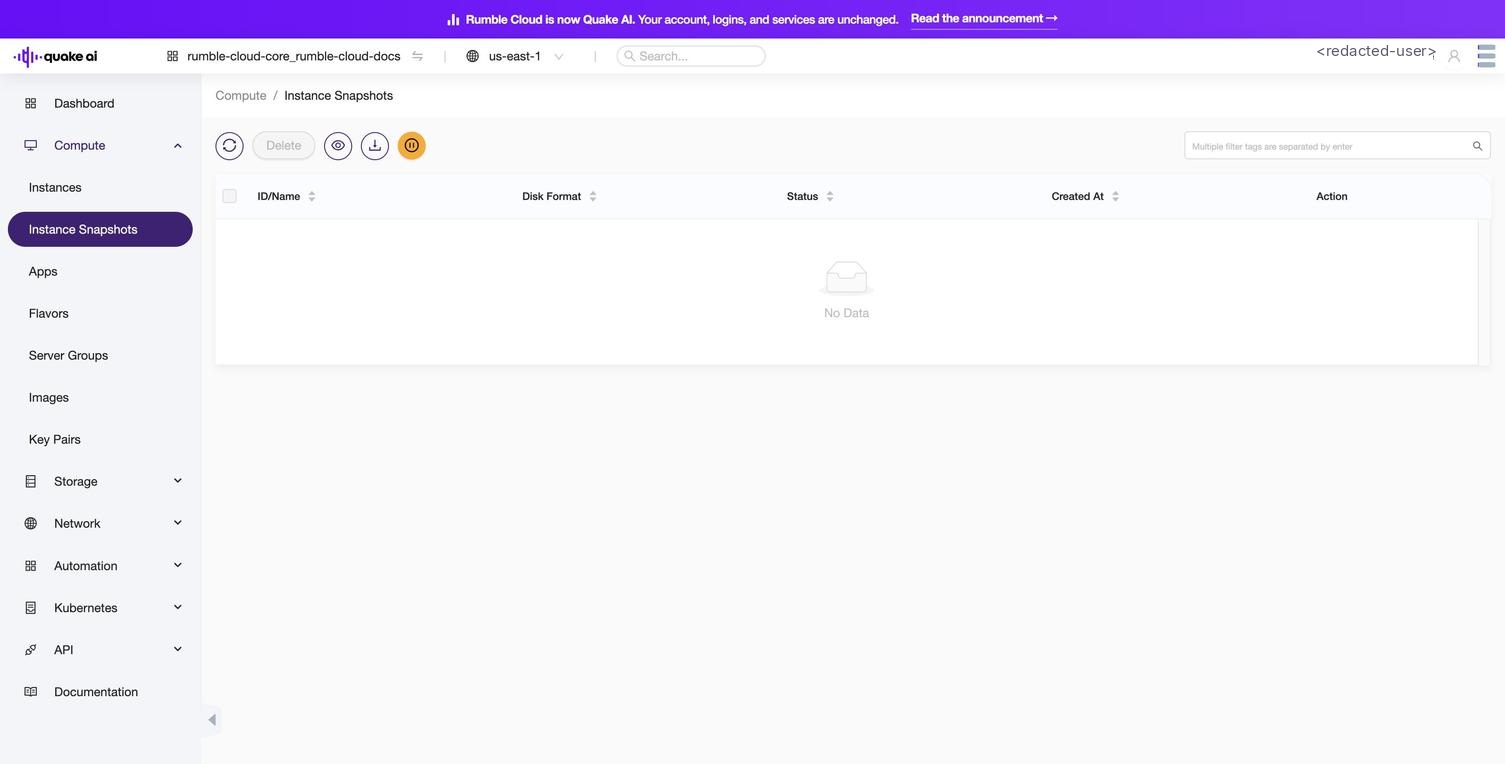
Instance Snapshots console showing an empty list with columns for name, type, status, and visibilityClick to zoom
Instance Snapshots console (empty state)

For each snapshot, you can take the following actions:

  • Edit
  • Create instance
  • Create volume
  • Delete

Instance snapshot details#

When creating or managing instance snapshots in the Compute service, you should be familiar with these properties and attributes associated with snapshots. Here's a list of key properties and attributes:

Property/AttributeDescription
NameA human-readable name for the snapshot, used for identification purposes.
IDA unique identifier automatically assigned to the snapshot by OpenStack.
StatusIndicates the current state of the snapshot (for example, queued, saving, active, deleted).
VisibilityDetermines who can access the snapshot (public or private).
ProtectedA boolean value indicating whether the snapshot is protected from deletion.
Disk FormatSpecifies the format of the snapshot (for example, raw, qcow2, vmdk, iso).
Container FormatDescribes the container format of the snapshot (for example, bare, ovf, aki).
SizeThe size of the snapshot file in bytes.
ChecksumA hash value used to verify the integrity of the snapshot file.
TagsA list of user-defined tags associated with the snapshot for categorization or filtering.
Instance IDThe ID of the instance from which the snapshot was created.
Volume ID (if applicable)For snapshots created from a volume, the ID of the source volume.
OwnerThe ID of the project or user that owns the snapshot.
Created AtThe timestamp indicating when the snapshot was created.
Updated AtThe timestamp indicating when the snapshot was last updated.

Understanding these properties and attributes is helpful for creating or managing instance snapshots in your cloud projects.

Instances service#

Instance snapshots CLI reference#

Instance service API reference#

See also#

Quick answers

Was this page helpful?