Predefined hardware-optimized series (e.g., D-family general purpose) with complex naming (e.g., Standard_D4as_v5), not user-defined vCPU/RAM like OpenStack flavors.
Sizes listed via API /providers/Microsoft.Compute/locations/{location}/vmSizes, region-specific availability.
Includes accelerator features (GPU, FPGA) baked into sizes, unavailable in basic OpenStack flavors without extensions.
Cannot create custom sizes; selection from catalog, limiting flexibility vs OpenStack flavor creation.
A Droplet must select a predefined “size” bundle (RAM/vCPU/disk/transfer) rather than choosing from an OpenStack flavor catalog that many clouds let you customize/extend at the project level.
The size object exposes explicit monthly pricing (price_monthly) and per-hour pricing (price_hourly) in the API response, whereas OpenStack clouds typically separate pricing from the Nova flavor definition.
DigitalOcean sizes embed transfer allowance and region availability directly in the size metadata, while OpenStack flavors generally describe compute resources and rely on separate networking/quotas/policies for bandwidth and availability.
DigitalOcean size classes are described in the API as categories like Basic, General Purpose, CPU-Optimized, Memory-Optimized, and Storage-Optimized rather than OpenStack’s provider-defined flavor naming/extra-specs approach.
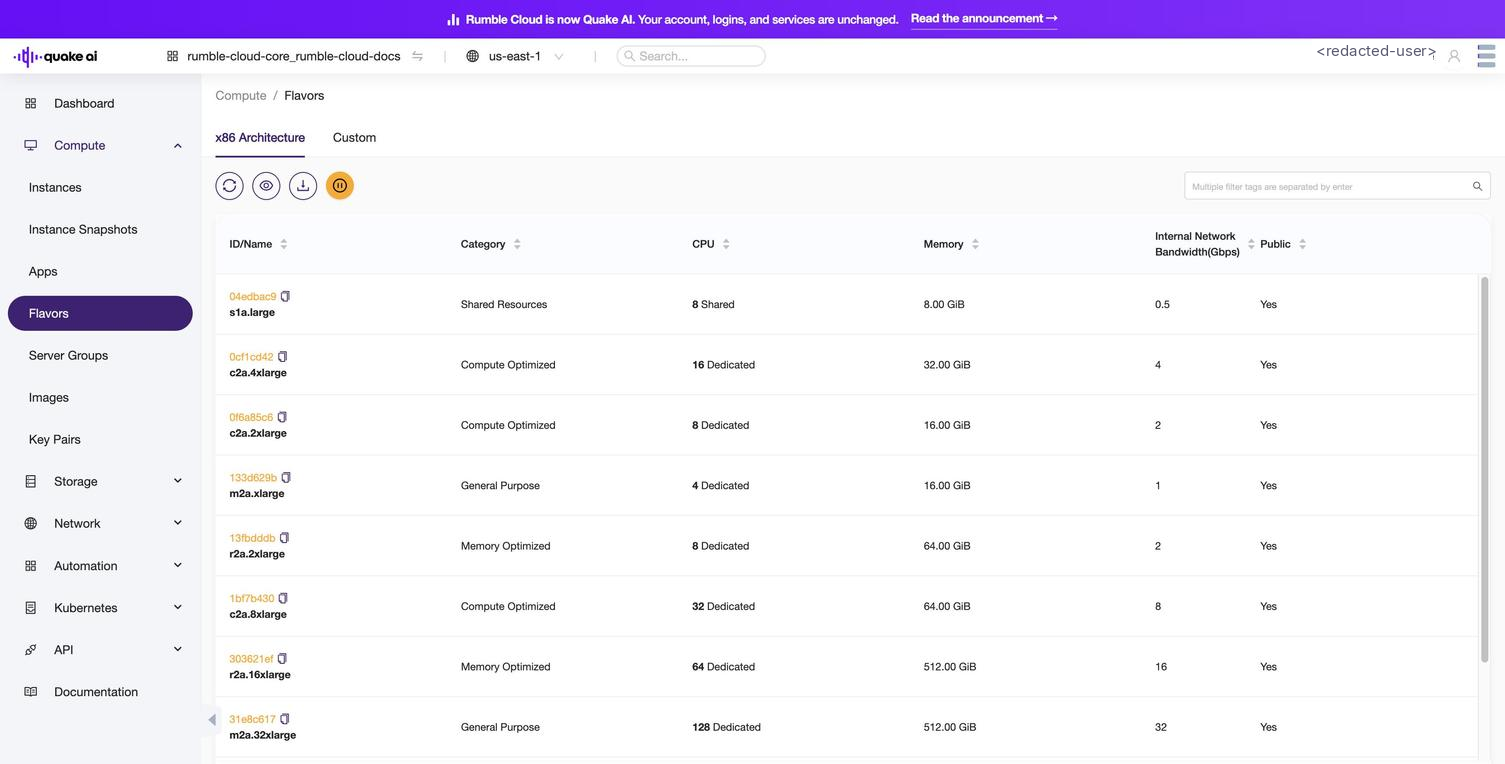
Flavors define the vCPU, memory, and disk resources allocated to an instance. Quake AI organizes flavors into four categories: General Purpose, Compute Optimized, Memory Optimized, and Shared Resources. For guidance on choosing between categories, see Flavors.
Select Compute > Flavors to view the Flavors console. The console uses two tabs:
x86 Architecture: pre-defined platform flavors available to all projects (listed below).
Custom: project-specific flavors created by your organization or assigned by Quake AI support. Custom flavors appear when your project has been granted access to non-standard hardware profiles (for example, GPU-attached instances or specialized memory/CPU ratios). If your project has no custom flavors, this tab is empty.
Click to zoom
Flavors console showing x86 Architecture tab with standard platform flavors
🖥️ General purpose (m2a) - dedicated vCPU flavors#
Here's a table summarizing the properties and attributes that you should understand to work with flavors in the Compute service:
Property/Attribute
Description
Name
A unique name identifying the flavor.
ID
A unique identifier automatically assigned to the flavor by OpenStack.
RAM
The amount of RAM (in MB) allocated to instances of this flavor.
VCPUs
The number of virtual CPUs allocated to instances of this flavor.
Disk
The size of the root disk (in GiB) for instances of this flavor.
Ephemeral
The size of the ephemeral disk (in GiB) for instances of this flavor (if applicable).
Swap
The size of the swap space (in MB) for instances of this flavor (if applicable).
RXTX Factor
The relative weight for network bandwidth allocation (used in some networking models).
Public
A boolean value indicating whether the flavor is accessible to all users or private.
Extra Specs
Key-value pairs defining additional specifications and capabilities for the flavor.
Is Public
A boolean value indicating whether the flavor is public or private.
Understanding these properties and attributes is helpful for selecting the appropriate size for your workloads based on performance and resource requirements.
 Click to zoom