Region-scoped: a VPC network is created in a specific datacenter region and resources must be in that same region to be attached, whereas OpenStack Neutron networks/subnets are generally available across all AZs in a region and attachments are controlled by network reachability rather than an explicit region slug ().
Resource migration is limited: Droplets require snapshot/recreate to move between VPCs and some resources (Kubernetes clusters, load balancers, NAT gateways) cannot be migrated between VPCs, whereas in OpenStack you typically can attach/detach ports or move router interfaces without recreating servers (behavior depends on deployment, but Neutron’s object model supports it) ().
NAT is a managed NAT Gateway with tiered capacity (1–16 increments; each increment gives 25 Mbps symmetrical bandwidth and 100 GiB outbound transfer/month) and can be set as the default gateway for the VPC, whereas OpenStack commonly expresses egress via Neutron routers with SNAT and does not use this specific ‘size tier’ model ().
Security-policy coupling differs: DigitalOcean notes Cloud Firewall rules affect both public and VPC traffic and rules must specify whether they apply to the public or private IP range, whereas in OpenStack security groups are generally applied to ports and are not framed as “public vs private IP range” rule modes ().
Ports are a fundamental component of networking in the Network service, providing the necessary connectivity and configuration for instances and other network resources to communicate within the cloud and with external networks.
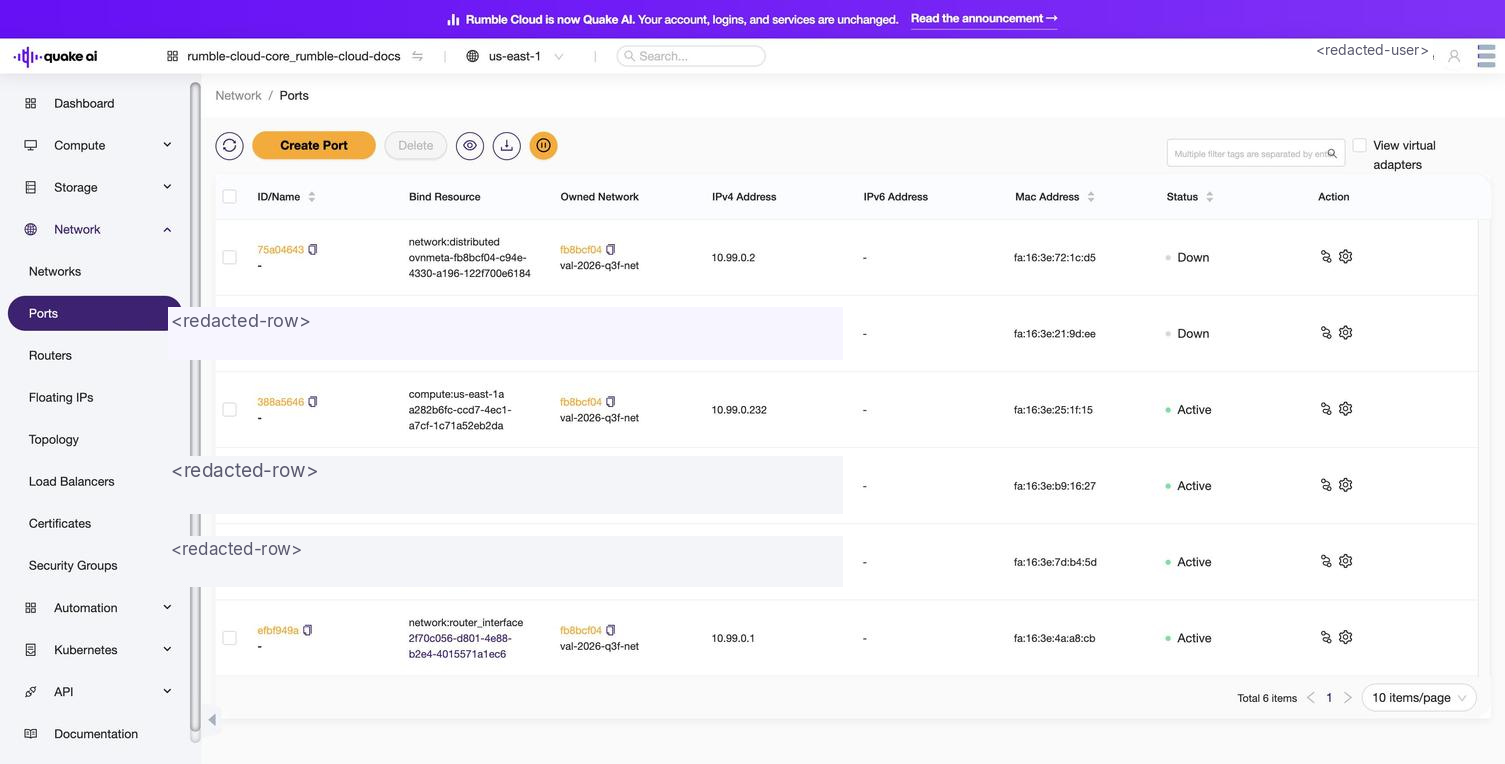
Select Network > Ports to show the ports console. The console displays a list of ports in the project.
Click to zoom
Ports console showing port IDs, bound resources, networks, and MAC addresses
 Click to zoom